
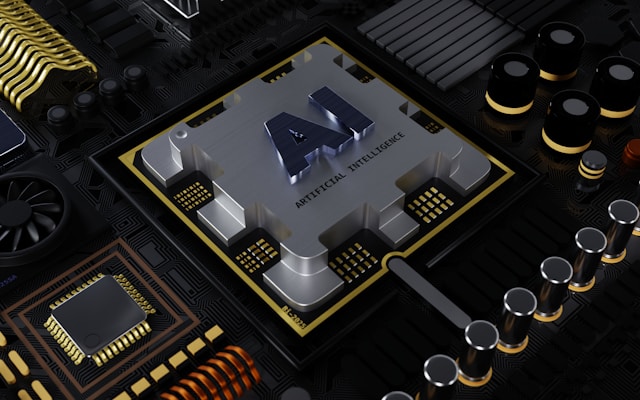
Is artificial intelligence a bubble? Or is it just the beginning of the biggest investment revolution? 🤖📈
Introduction – everyone is talking about AI… and that’s exactly what makes people nervous 😏
Artificial intelligence is everywhere today.
Headlines, earnings calls, conferences, YouTube, X, coffee chats.
Some people say:
👉 “This is the new Internet”
👉 “If you don’t have AI in your portfolio, you’ll be left behind”
Others warn:
⚠️ “It’s a bubble”
⚠️ “Too expensive”
⚠️ “Too much hype, not enough real profits”
And now the key question more and more investors are asking:
Is artificial intelligence a speculative bubble…
or just the beginning of something truly massive?
No clickbait. No drama. Calmly. Rationally 🧠
Let’s break it down step by step.
What is a market “bubble,” really? 🎈
Before we judge AI, let’s define one thing.
A market bubble is when:
🔹 prices rise faster than real value
🔹 investors buy “because it’s going up,” not “because I understand it”
🔹 narrative dominates fundamentals
🔹 FOMO, euphoria and risk-blindness appear
Sound familiar? 😅
That’s what the dot-com bubble, housing bubble and some crypto phases looked like.
So the question is: does AI fit this pattern?
Why many believe AI is a bubble 🤯
Let’s be honest — the arguments against are strong.
1. Valuations are very high 💸
Many AI-related companies have:
📊 high valuation multiples
📊 enormous growth expectations
📊 prices that assume an “ideal future”
The market is pricing what might happen — not what already exists.
And that always carries risk.
2. AI is being slapped onto everything 🙃
Today almost every company says:
“We do AI too.”
The problem?
Not every company actually earns money from AI.
Sometimes it’s just marketing and buzzwords.
That’s a classic investor warning sign.
3. Emotions and FOMO are strong 🔥
Many investors buy AI stocks because:
👉 “everyone else is buying”
👉 “I don’t want to miss out”
👉 “this must keep going up”
And that is never a good investment reason.
Now the other side — why AI is much more than a bubble 🚀
And here it gets really interesting.
1. AI is changing the real world (not just the narrative) 🌍
This isn’t a “PowerPoint project.”
Artificial intelligence already:
✅ automates work
✅ lowers company costs
✅ boosts productivity
✅ supports medicine, finance, logistics, cybersecurity
✅ improves analysis and decision-making
It’s a tool — not a toy.
2. This is an Internet-level technology 📡
Comparisons to the dot-com bubble are popular —
but there’s one catch:
The Internet didn’t disappear when the bubble burst.
Only weak companies did.
What remained?
Amazon, Google, Microsoft.
AI may follow the same path.
3. The biggest players are investing billions 💰
This is not a garage experiment.
The world’s largest tech companies:
🔹 invest billions in AI infrastructure
🔹 build models, chips and data centers
🔹 create long-term competitive advantages
That doesn’t look like a short-term fad.
AI is a sector — not a single stock 🧩
This matters a lot.
“AI” is not one ticker. It’s an ecosystem:
🔹 hardware & chips
🔹 cloud infrastructure
🔹 software
🔹 cybersecurity
🔹 data analytics
🔹 process automation
Some companies may be overpriced.
Others are just beginning.
And that’s exactly where smart investors operate.
Where could the real bubble burst? ⚠️
Not in the technology itself.
Bubbles usually burst in:
❌ companies with no real revenues
❌ firms living only on narrative
❌ projects that are “AI in name only”
❌ investors buying without a plan
The technology survives.
Capital without discipline — doesn’t.
How to invest in AI wisely — not emotionally 🧠📊
1️⃣ Don’t buy “because it’s going up.”
Buy because you understand the business.
2️⃣ Focus on fundamentals
Revenue, margins, customers, competitive edge.
3️⃣ Diversify
Don’t bet everything on one AI story.
4️⃣ Have an exit plan
Every investment needs a “what if?” scenario.
5️⃣ Separate technology from valuation
Just because something is the future
doesn’t mean it’s cheap today 😉
Can AI experience a correction? Of course 📉
And that’s totally normal.
Corrections, cooling sentiment, volatility —
these are parts of a healthy market.
They don’t destroy a trend.
They clean it up — removing the weakest players.
For a long-term investor a correction isn’t the end.
Sometimes it’s… an opportunity.
My approach — no euphoria, no fear 🧭
I don’t believe in extremes.
AI is:
❌ not a “magic money machine”
❌ not an “empty hype bubble” either
It is a powerful trend that:
✔️ will transform many industries
✔️ will create winners and losers
✔️ will reward patience
✔️ will punish emotional decision-making
And that’s exactly how I look at it.
Summary — bubble or revolution? 🎯
👉 Is there a lot of hype around AI? Yes.
👉 Are some companies overpriced? Yes.
👉 Will AI disappear? Absolutely not.
The truth lies in the middle.
Artificial intelligence is a real technological revolution —
but the market, as always, may overdo expectations.
Your job as an investor is not to guess the top.
Your job is to manage risk, emotions and capital.
Because at the end of the day:
📈 those who shout the loudest don’t win
🧠 those who think the calmest do

Artificial intelligence in practice — concrete AI sectors and companies driving the market 🤖📈
Introduction – AI isn’t one company, it’s an entire ecosystem 🌍
When someone says “I invest in AI,” I always ask one question:
👉 what exactly?
Because artificial intelligence isn’t one ticker and not one industry.
It’s a whole ecosystem — where some companies are already earning billions, and others are just trying to catch the narrative.
If you want to invest in AI without FOMO and without guessing, you need to understand sectors — not just headlines.
Let’s break it down 👇
🧠 1. AI infrastructure — the foundation of the whole revolution
Without computing power, AI… simply doesn’t exist.
This is the sector closest to real money.
What’s happening here?
data centers
servers
compute power
cooling
networks
Examples of companies:
🔹 NVIDIA — the king of AI chips
🔹 AMD — the key challenger
🔹 Intel — fighting to return to the game
🔹 Super Micro Computer — AI-focused servers
👉 This is the “shovels and picks” sector — they earn regardless of who wins the app race.
☁️ 2. Cloud & hyperscalers — AI as a service
AI needs data.
There’s a lot of data.
And data… lives in the cloud ☁️
What’s happening here?
training models
data storage
scaling compute
AI “on demand”
Examples of companies:
🔹 Microsoft — AI deeply integrated into business
🔹 Amazon — infrastructure + cloud
🔹 Google — data + models + advertising
👉 A more stable, defensive sector than “pure AI,” but with massive impact across the economy.
💻 3. AI software & applications — the biggest potential… and risk
This is where the products the end-user actually sees are built.
And it’s also where the most hype lives.
What’s happening here?
work automation
data analytics
business tools
content generation
Examples of companies:
🔹 Palantir — AI-driven data analytics
🔹 Adobe — AI in creativity
🔹 Salesforce — AI in CRM
🔹 ServiceNow — workflow automation
👉 The biggest winners are here — but also the biggest disappointments.
Not everything branded “AI” will survive.
🔐 4. Cybersecurity — AI vs AI
Hackers use AI.
So companies must use better AI to defend themselves.
What’s happening here?
anomaly detection
behaviour analysis
real-time threat response
data & identity protection
Examples of companies:
🔹 CrowdStrike — endpoint security leader
🔹 Palo Alto Networks — infrastructure & network security
🔹 Fortinet — network protection
🔹 Zscaler — cloud-native security
👉 A sector that grows regardless of the cycle.
Cybersecurity isn’t a trend — it’s a necessity.
🏥 5. Healthcare & biotech — AI that saves lives
Here AI doesn’t just make money.
It changes people’s lives.
What’s happening here?
drug discovery
diagnostics
medical imaging
personalised therapies
Examples of companies:
🔹 Moderna — AI in research
🔹 Illumina — genome analytics
🔹 Tempus — medical data + AI
👉 Huge long-term potential — but high research and regulatory risk.
🏭 6. Industry, robotics & automation
AI in factories, logistics and production.
What’s happening here?
process optimisation
industrial robots
autonomous systems
cost reduction
Examples of companies:
🔹 Tesla — AI + automation
🔹 ABB — industrial robotics
🔹 Rockwell Automation — intelligent manufacturing
👉 Less “sexy,” but highly stable and long-term.
🚗 7. Automotive & autonomous systems
Cars, drones, logistics.
What’s happening here?
driver-assistance systems
autonomous vehicles
AI in transport
Examples of companies:
🔹 Tesla
🔹 Mobileye
🔹 NVIDIA (software + hardware)
👉 Huge potential — but also big promises and regulation risk.
⚠️ Where should you be most cautious?
❌ companies with no revenue
❌ “AI-in-name-only” firms
❌ projects built purely on narrative
❌ excessive valuations without numbers behind them
Not every AI company will be a winner.
And that’s OK.
🧠 How do I look at AI investing?
No euphoria. No panic.
✔️ sector diversification
✔️ mix of stable and growth companies
✔️ focus on fundamentals
✔️ risk management
AI is the trend of the decade —
but the market always overdoes things in both directions.
Summary — AI is a marathon, not a sprint 🏃♂️
Artificial intelligence is not one company, one sector or one year.
It’s a multi-layered revolution that is only just beginning.
If you approach it calmly, selectively and consciously —
AI can be an opportunity, not a bubble.
But if you throw money at everything with “AI” in the name…
the market will teach you a lesson very quickly 😉